How adherence works in Erlangly
How Erlangly measures schedule adherence, and where it shows it: your ACD's state codes mapped to Erlangly's states, what each scheduled activity needs and how exceptions count; one real 15-minute interval scored second by second; the live wallboard; the adherence report by person, team or line of business; and Intraday's Service, Staffing and Hours tabs. Erlangly's sample contact center, one Monday played through.
Chapters
- 0:00 Adherence asks one question
- 0:11 What counts
- 1:18 How it's scored
- 2:09 Right now
- 2:40 Over days
- 3:18 Intraday: Service
- 3:44 Intraday: Staffing
- 4:19 Intraday: Hours
- 5:01 What you set
- 5:36 Close
Transcript
Adherence asks one question: did each agent do what the schedule asked, when it asked? Here's how Erlangly answers it, and where you'll see it.
It starts with two tables. The first is yours. Your phone system sends its own state codes, and an admin maps each one to Erlangly's states: available, on a call, after-call work, break, aux with a reason, logged off and logged in. A code nobody has mapped yet counts as no data, never against anyone. The second table says what each scheduled activity needs. On the phone means available, on a call or in after-call work. A break or lunch means on break. Training means aux, with the reason training, and so does nesting, on a new install, since a nester is mostly off the phones. Time off means logged off. And an exception, like going home sick, replaces the schedule with what the person did instead: once a supervisor approves it, or at once, for the kinds you choose. Who approves is yours to set: any supervisor or planner, the agent's team lead, or planners only.
Here's one real interval. Kemar Henry's break ended at nine. For the next 15 minutes, his schedule says on the phone. His states say he stayed on break until eight minutes and fifty seconds past, then went available. Erlangly compares the two, second by second: eight minutes fifty out, six minutes ten in. Adherence is the time in, over the time in and out: forty-one percent, for this interval. Time with no data counts neither way. Each interval is scored a minute after it closes, and states that arrive late are scored again, up to a week back. A break moved before it's taken is scored at its new time. It's exact to the second by default. You can set a grace of up to ten minutes, for a call that runs into a break, or a late login.
On the floor, the wallboard shows it live. At ten forty-seven on Monday, ninety-two percent of the floor is in adherence: twenty-three of two hundred and ninety-five scheduled agents are out. Each tile shows an agent's state, how long they've been in it, and what the schedule asks. Filter to out of adherence to see who to talk to. Three alarms watch the states that run long: after-call work, break and lunch, each after a time you set.
For any range of days, the adherence report sums it up by person, by team or by line of business, lowest first, so you know where coaching should start. Under ninety percent turns red. Time with no data from your phone system has its own column, so a gap in the feed never looks like an agent's fault. By person, it also counts absences, for your own attendance rules: the kinds of exception and time off you say count, sick to start with. It never changes the adherence figure.
Intraday puts the day beside the plan. The Service tab has contacts against the forecast, handle time, service level against its target, answer rate, abandons and occupancy. Every figure is worked out from the counts, not averaged, for one day or up to thirty-one: in total, by day, by time of day, or every interval.
The Staffing tab is the people: agents needed, with and without shrinkage, scheduled, and productive, the time actually on the phones. Adherence here counts only the time scheduled productive, so a training session doesn't blur the number that matters for the phones. And where a line's contract measures line adherence, each interval is scored against it. Billing's asks for productive at ninety-five percent of needed or more, in ninety percent of its 15-minute intervals. On Monday, every interval passed.
And the Hours tab shows where the time went. On Monday, Billing planned one thousand eight hundred and ten agent hours. Less time away, here a vacation. Less exceptions: someone who went home sick. Less breaks and lunch. Less time not productive when it was scheduled to be. Plus overtime, and time productive when something else was scheduled. That leaves one thousand five hundred and seventy-six productive hours, against one thousand two hundred and forty-one needed: forty-four and a half FTE over. Every hour is accounted for.
What you set: the state mapping, and the alarm times. For each kind of exception, whether it waits for a supervisor or counts at once, how long one may run before it needs approving, and whether it counts as absence. Who approves them. The grace, if you want one. And each line's service target, line adherence included, from the day it starts.
Erlangly. Install it free, at erlangly.com.
More films
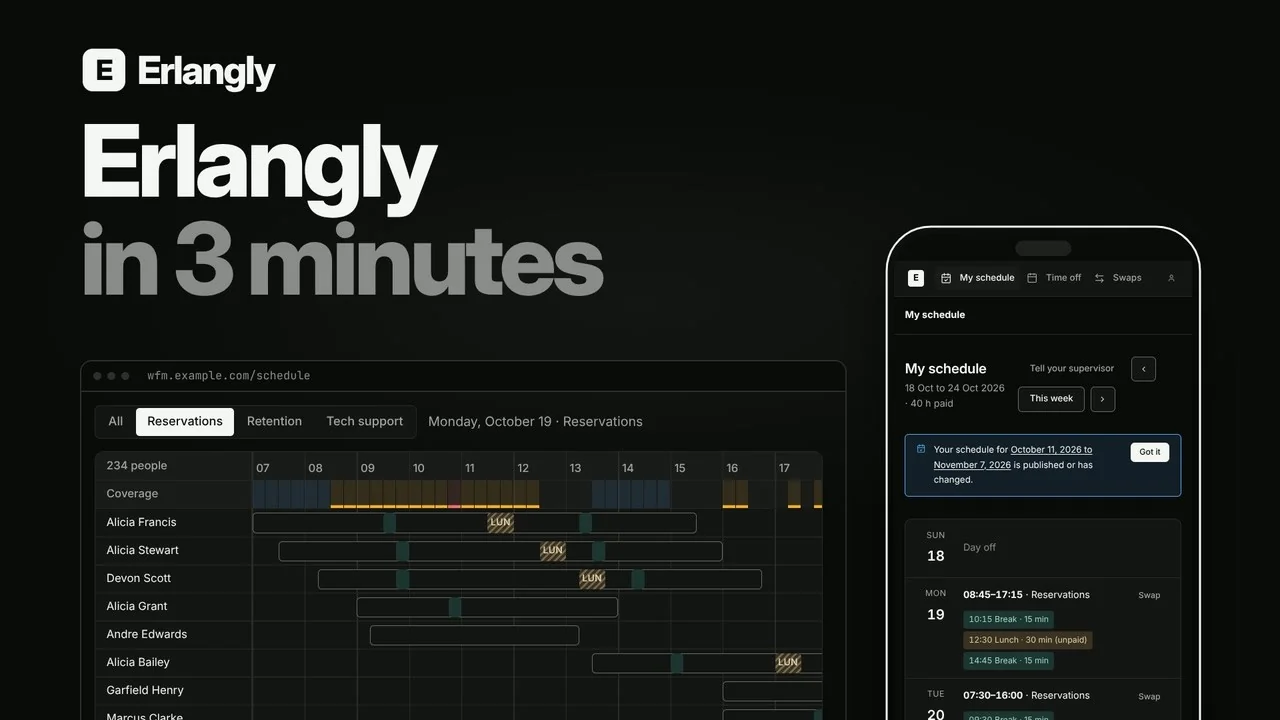 Erlangly in 3 minutes: self-hosted workforce management for contact centers and BPOs 2:55
 Self-hosted call center workforce management 0:47
 Forecast to adherence in one interval: Erlangly for WFM planners 9:20
 Erlangly for supervisors 4:10
 Erlangly for agents 2:03
 Erlangly for systems administrators 9:06
 How labor rules work in Erlangly 5:30
 How notifications work in Erlangly 3:24
 How to connect Claude to Erlangly 2:50
 How to connect ChatGPT to Erlangly 2:50