Connecting NICE CXone (beta)
Erlangly connects to NICE CXone itself: it checks your agents' states every 5 seconds (for adherence and the wallboard) and reads your skills' volumes every 15 minutes (for forecasting), with the last 13 weeks when you first connect. It only reads, and it connects out to CXone, so nothing on your network has to be reachable from the internet. It's built from NICE's API documentation and marked beta until more customers run it: if anything looks wrong, the connection's page has a diagnostics file to send us.
1. In CXone: an app registration, a user, a role and an access key
- Start with the slowest step: register a back-end app with NICE (on NICE's developer portal, as a single-tenant app). NICE sends its client ID and secret, which can take a few days. (Erlangly's own registration with NICE isn't available yet.)
- A CXone admin makes a role for Erlangly that can only view: agents (employees), their real-time states, unavailable codes, skills and contact reports.
- They make a user for Erlangly with that role, then open it under Admin → Employees → Access Keys → Generate New Access Key.
- Copy the access key ID and secret. The secret is shown only once.
2. In Erlangly: connect
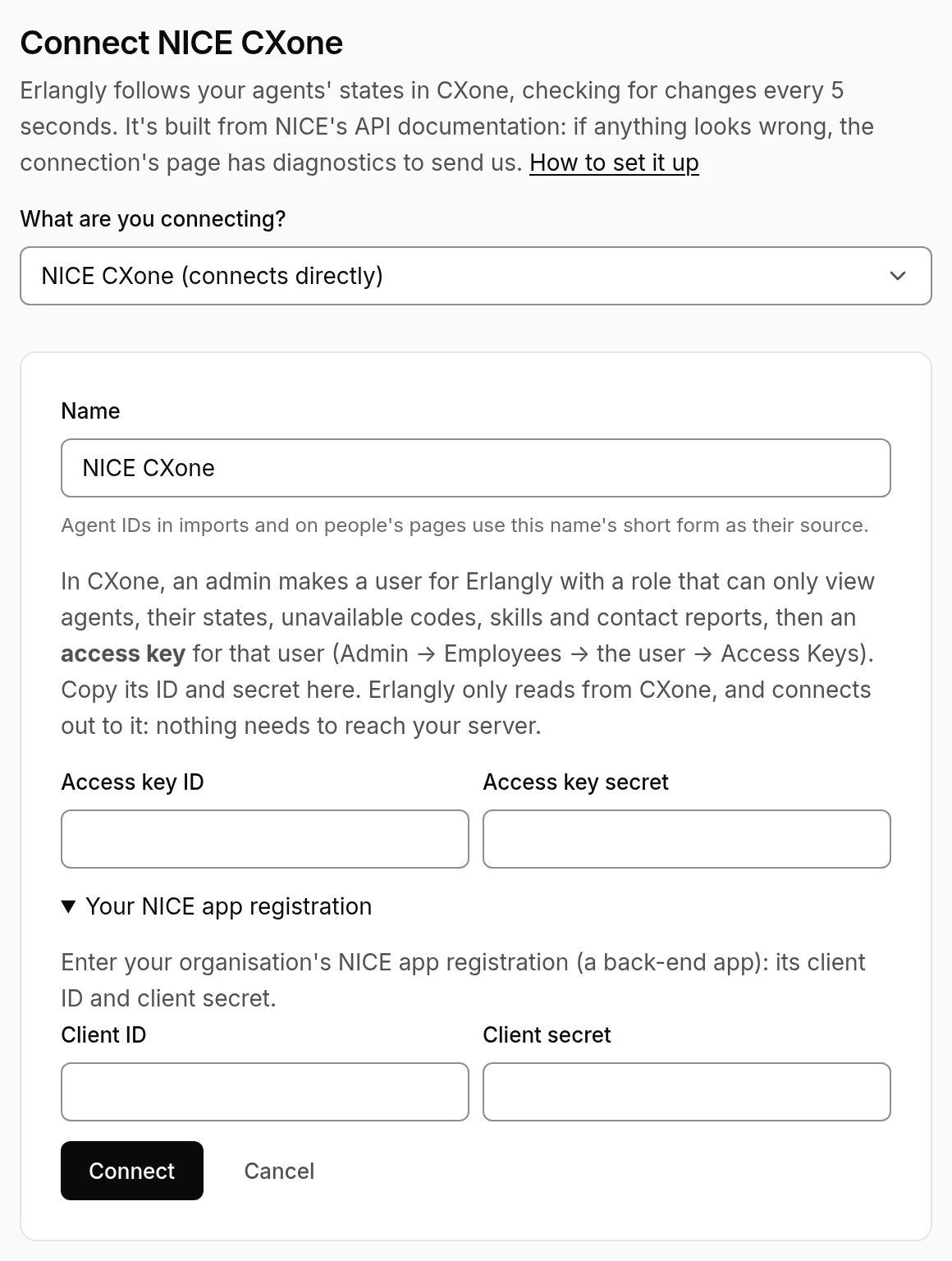
- Settings → Connections → Add a connection → NICE CXone, and paste the access key's ID and secret. Erlangly finds your tenant through NICE and checks the key before saving. Enter your NICE app registration's client ID and secret under Your NICE app registration.
- State codes: CXone's states and unavailable codes come mapped: Available → Available, inbound and outbound contacts → On a call, logged out → Offline, and Unavailable by its code (Lunch → Lunch, Break → Break, Training → Aux…). After-call work comes from CXone itself, whatever your code for it is called. Check them, and change any that mean something else on your floor.
- Agents link by email the first time: someone active in Erlangly with the same email as in CXone. Anyone else shows up under the connection to link by hand.
- Queues: choose the line of business each inbound skill feeds (dialler skills aren't listed). Erlangly counts each skill's completed contacts, offered, handled, handle time and abandons, into your intervals: the last 13 weeks straight away, then every 15 minutes. It asks CXone only for what counting needs, never callers' details.
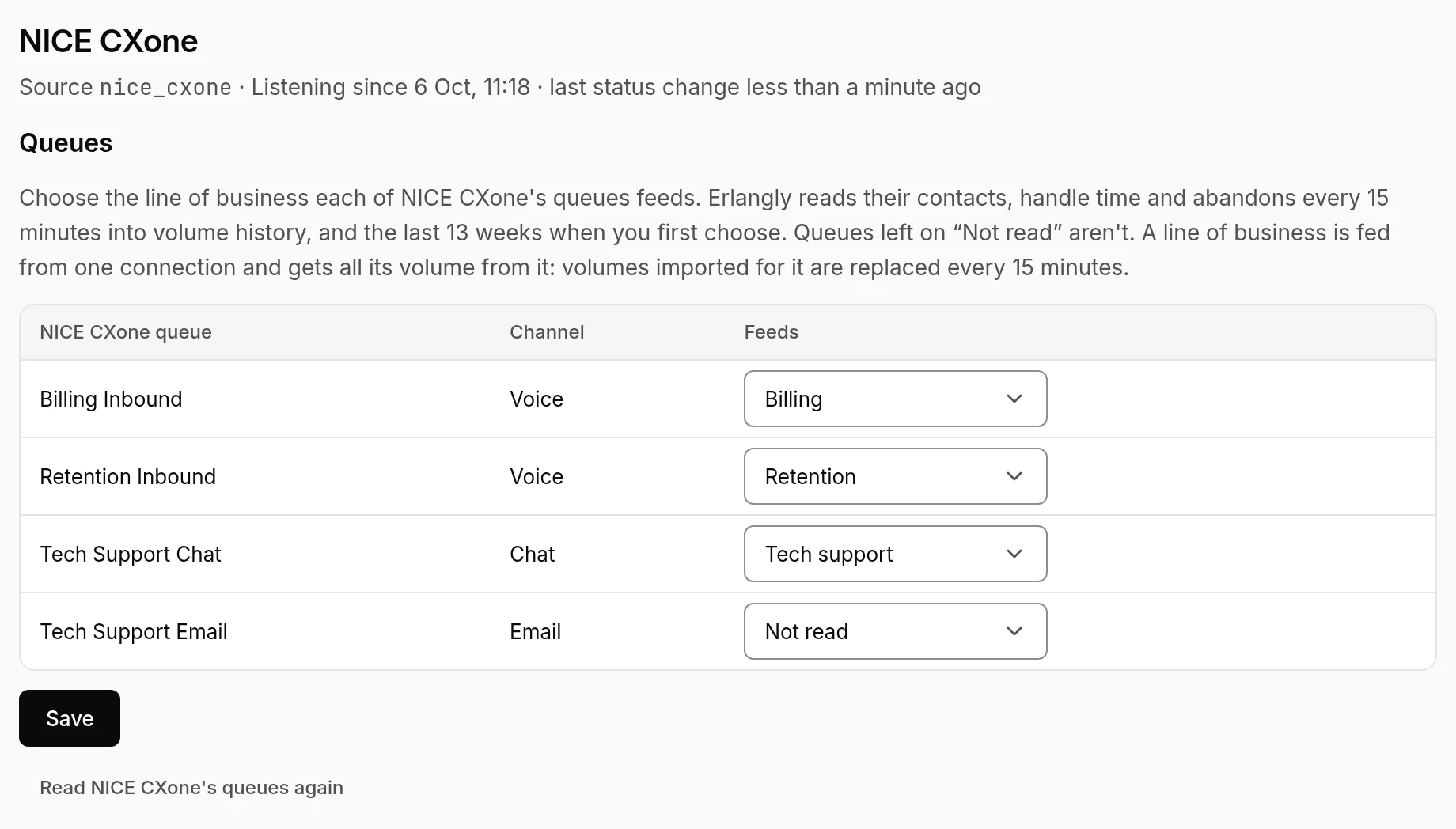
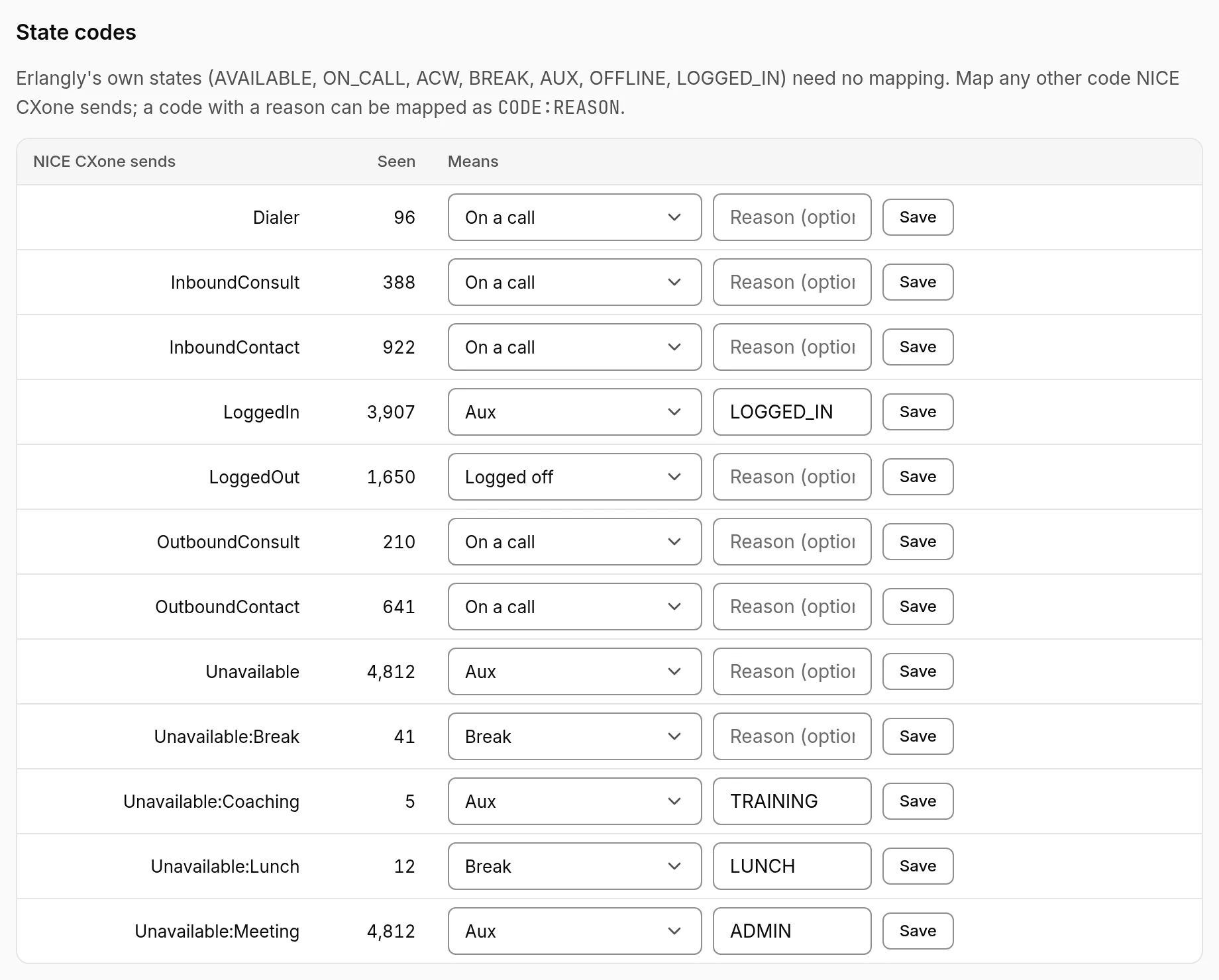
The connection's page shows whether Erlangly is following CXone, when the last state change came, and what CXone sent (names and callers' details masked). If CXone refuses the access key or the registration, it says which, and keeps trying.